Rekenreks – ‘see’ and ‘push’
What is a rekenrek?
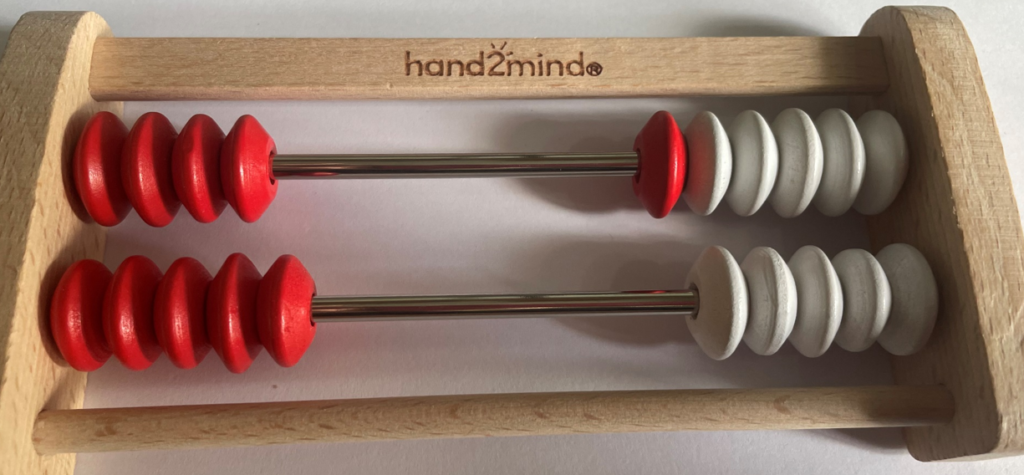
The rekenrek is a concrete mathematics manipulative that supports children’s understanding of place value and its underlying structures. It is made up of two fixed rows of red and white beads, grouped into 5s, with a row of 10 at the top and another on the bottom. It is an informal and dynamic representation that enables children to visualise numbers and ‘do’ maths.
What areas of maths does it relate to?
• subitising – children can ‘see’ groups of 5 and 10, and subitise numbers in between without having to count them
• one-to-one correspondence – each bead corresponds with a number in the counting sequence
• cardinality – children begin to see that the last bead pushed to the right shows how many in that set
• decomposition and composition – allows children to see the parts that make up the whole (e.g. 10 is made up of 5 and a 5)
• building numbers from 11-20 – bridging 10
• counting on counting back – in groups of numbers (2s, 5s and 10s)
• addition and subtraction – children can either use the top and bottom rows to compare numbers or push in either direction dependent on the calculation. The beauty of pushing from left to right for subtraction (defying the golden rule of right to left) is that it demonstrates the importance of having enough beads to subtract from (you may hear this initial amount referred to as the minuend)
• halving (and even numbers) – showing an even number on the top row and then finding half of it on the row below
• doubles and near doubles (even and odd numbers) – using both rows, the children can push 3 on the top row and 2 on the bottom, seeing that 2 is a near double of 3 (one more and one less)
• early multiplication – recognising multiplication as repeated addition
How do you use a rekenrek?
Start with all beads to the right of the frame – this is the ‘ready’ position. While it might seem counter-intuitive to do this, the number work will be happening on the left as the beads are moved across (your school’s consistency of approach with this will support children’s familiarity with the representation). While the rekenrek can be successfully used to count in ones, it is designed to support cardinality and subitising – not needing to count all the beads in a set or group because they can be seen. Children who are ready to do so should be encouraged to ‘push’ a particular number of beads to the left (for example, pushing 5 beads to the left hand-side of the frame and then pushing 3).
How should you introduce the Rekenrek to children?
We would recommend giving children some time to play with the resource first (useful when you introduce any new kind of manipulative), leading into a question such as ‘What do you notice?’. While some answers will describe the immediately obvious, this type of questioning supports children’s attention to detail and awareness of mathematical structures.
What can you suggest if children are struggling to ‘see’ a number?
1. Always start with the beads in the ‘ready’ position (to the right of the rekenrek)
2. Support children to look at the rekenrek without touching it. Ask them to see 1 by really focusing on the particular bead (the one that is closest to the left-hand side of the rekenrek). When they ‘see’ this, ask them to push it across to the other side. Return all beads to the right-hand side of the wire before trying the same activity again with 2 beads and so on. The aim is to support children to move the beads with one push rather than many.
3. If children are struggling with numbers to 10, the bottom row can easily be covered with a piece of folded card.
How use of the rekenrek will support children’s later understanding at primary school
conservation of number – when a particular number of beads is pushed across the wire, the quantity stays the same even though the beads have moved. Understanding this at a young age will support children’s growing understanding of mathematics as they progress through primary school.
associative law – when adding, the order is irrelevant (e.g. pushing 1 bead and 4 beads – to make a group of 5 – before adding 3 more beads will give the same result as pushing 3 beads, then another 3 beads and then 2 more beads). Recognising this will support children’s later fluency with number.
commutative law – using the rekenrek, children can begin to see that adding 3 beads to 5 beads will give the same quantity as adding 5 beads to 3. Recognising this will support children’s fluency with number and their later thinking around addition and multiplication.
distributive law – pushing 4 groups of 3 beads (4 x 3) gives the same answer as pushing 2 groups of 6 beads (2 x 6). Having an awareness of this will support children’s later understanding of multiplication (composite numbers, factors and multiples). Teachers have traditionally taught this concept using arrays, but the rekenrek is a great hands-on representation to support this.
… the thinker who fluently produces a number of possible solutions to a problem is usually more successful than the thinker who settles for one…’ (Robert McKim, 1980, Stanford University)